
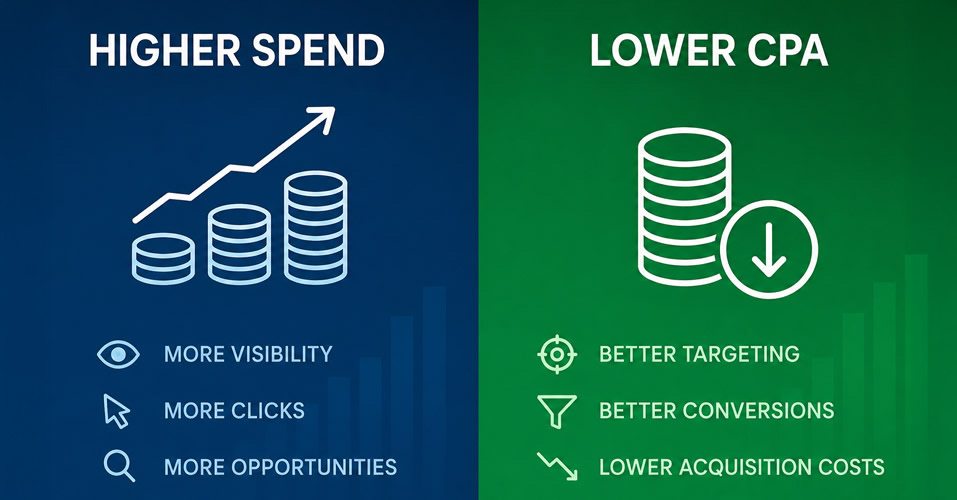
Sponsored listings in search results such as Google and Bing go by many names. You may have heard them called PPC (pay-per-click), Google Ads, paid search, SEM (search engine marketing), or search advertising. Whatever the label, the principle is the same, placing your business in front of people actively searching for what you offer.
At its simplest, a successful PPC campaign is one that genertes profitable enquiries or sales at a cost that makes commercial sense for your business.
That cost is commonly known as CPA (cost per acquisition), which is effectively how much it costs to generate a lead, sale, or customer.
The goal is not cheap clicks
One of the biggest misconceptions about PPC is that success is about getting the cheapest clicks possible.
It is not.
A £1 click that generates no enquiries is expensive. A £10 click that generates profitable business can be extremely good value.
The real aim is to generate as many quality enquiries or sales as possible for the lowest sustainable CPA.
What does success look like?
A very common pattern in paid search looks something like this:
- A business starts cautiously with a modest advertising budget
- The campaign begins generating enquiries at an acceptable CPA
- Confidence grows because the advertising is producing measurable results
- Budget increases to generate more enquiries
- Campaign performance improves further as more data becomes available
The example below shows a simplified but very common scenario.
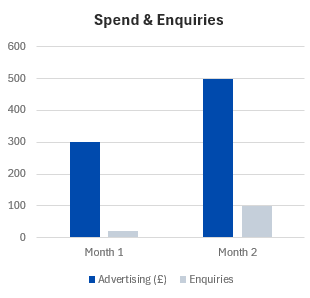
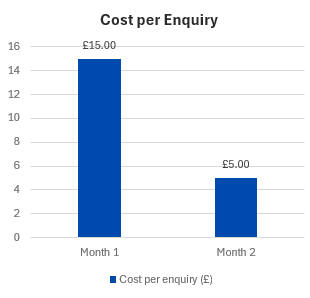
Although advertising spend increased in Month 2, the cost per acquisition (CPA) dropped significantly. In simple terms, the business received more enquiries for its money.
In this example:
- Month 1 spend: £500
- Month 1 CPA: £15
- Month 2 spend: £1,000
- Month 2 CPA: £5
That is excellent.
The business spent more overall, but received significantly more enquiries for their money, more bang for their buck.
So does more budget always mean lower CPA?
Unfortunately not.
If only it were that easy.
Every form of marketing has limits, risks, and points of diminishing return. Increasing spend does not automatically guarantee better results.
At some stage you may:
- exhaust the available search demand
- begin targeting broader, less relevant searches
- face increased competition
- encounter rising click costs in competitive industries
A good PPC campaign is not about endlessly increasing spend. It is about finding the balance between volume, profitability, and sustainability.
What actually makes PPC campaigns successful?
Relevant targeting
Showing adverts to people actively searching for your products or services.
Strong advert copy
Clear messaging that gives people confidence to click.
Good landing pages
The experience after the click matters enormously. Even excellent adverts struggle if the website is slow, confusing, or unconvincing.
Conversion tracking
If you cannot measure enquiries, calls, purchases, or leads properly, you cannot improve campaigns effectively.
Ongoing optimisation
PPC is not a one-off setup. Successful campaigns are refined continuously using real performance data.
Looking beyond the initial sale
As a business owner, it is important to think beyond the value of a single transaction.
A customer acquired through PPC may:
- become a repeat customer
- recommend your business to others
- leave positive reviews
- generate long-term revenue far beyond the initial enquiry
This is why CPA should always be viewed in context.
For example, paying £40 to acquire a customer might initially sound expensive if their first purchase is worth £60. But if that customer returns several times a year, or refers other customers to your business, the picture changes entirely.
Measuring the real value of a customer
Surprisingly, many businesses never properly calculate customer lifetime value, even when they already have enough information to estimate it. Even fewer are equipped to accurately follow an enquiry all the way through to a completed sale or booked service.
In ecommerce, the transaction itself is usually the clearest measurement of success. For service businesses, however, there are often far more variables involved. A phone call, form submission, or email enquiry does not automatically become revenue.
Because of this, business owners often need to make practical commercial assessments about whether the cost per acquisition feels worthwhile for their business.
At Sumobaby, we focus heavily on measurable data, reporting, and transparency. We aim to provide clients with clear facts wherever possible. But the reality is that, due to the challenges above, many businesses still ultimately make a commercial judgement based on whether the enquiries being generated appear valuable and sustainable.